
SERIES: BETWEEN NOISE AND SILENCE PART 2: WHEN MASTERY BECOMES A CAGE
This next section is the introduction to the series and is a repeat from part 1. So you can skip it, if you've already read it.
When Silence Becomes a SpaceW
The silence I speak of isn’t the absence of sound.
It’s the absence of what clutters the mind — the noise of expectations, comparisons, judgments.
It’s an inner stillness, fragile and shifting, found not by shutting out the world,
but by stepping back from the commotion for a moment.
I can listen to music, an audiobook, or the wind outside — it doesn’t matter.
This kind of silence doesn’t depend on the environment but on intention:
the intention to create from a place that is honest and sincere,
without trying to please or conform.
It’s a form of active listening —
listening to what rises, even when it’s blurry, vulnerable, or uncomfortable.
To create, for me, is to keep returning to that place —
where outer noise fades just enough
for a truer presence to emerge.

PART 2: When mastery becomes a cage
Coming Back to Myself
After many art classes — drawing, painting, sculpture —
I had become skilled at producing what was expected of me.
My work was solid, “beautiful.”
But its message felt muted, restrained —
as if passing through an invisible filter.
Beneath that surface, a quiet tension built — a kind of anger.
Each time I adjusted, softened, or censored myself, it grew stronger.
The critic: It’s not good enough. Not yet.
Me: Why this anger?
The critic: Keep working. Don’t listen too much. They know better.
Me: Let me breathe.
So I paused. Not to escape, but to listen.
And in that pause, the silence arrived.
Guilt
Then came another visitor — guilt.
The guilt of taking time for myself, for art.
The critic: You’re not Rembrandt. Do something useful.Go back to the norm — to exhaustion, where everyone feels legitimate.
But even then, a quiet part of me knew I had to keep going.
For months, I experimented, hesitated, searched for rhythm.
I was torn between the demanding voice
and the one trying to come back to life.
Eventually, I understood I couldn’t silence them.
I had to learn to recognize them —
to keep moving, despite the critic, despite the doubt.
The Voice of Doubt
For a long time, I believed mastery protected me —
not from discomfort, but from the fear of being an impostor.
It gave me the illusion of control — of holding things together,
of knowing something. A shield for vulnerability.
But with time, I realized it was mostly a mask —
a way to hide from doubt, from the fear of being wrong,
or worse — from being seen as I am.
Doubt always returns.
It’s how my mind tries to protect me —
to delay the moment I must choose, take a stance, expose myself.
This uncertainty is uncomfortable.
I question, refine, adjust —
sometimes until the first impulse fades away.
And yet, that’s what creation is: deciding, trying, failing, trying again.
Each imperfect decision carves a direction,
turning hesitation into movement.
Discomfort never disappears.
It only changes form —
the critic, the guilt, the doubt, and sometimes, exploration.
Learning to listen to those voices without obeying them
is learning to create from alignment rather than fear.
Between Structure and Freedom
Over time, I’ve found a fragile balance.
I need variety, but also structure —
a rhythm that supports without suffocating.
It helps clear space in my mind,
so something new can emerge.
But most of all, I need solitude — in the studio, and in nature.
Moments without judgment, without expectation, without noise.
The critic: You should be learning more, producing more, connecting more.
The quiet voice: I’m not isolating. I’m listening.
That’s when my inner world begins to speak —
through images, sensations, sometimes words.
And that’s enough.
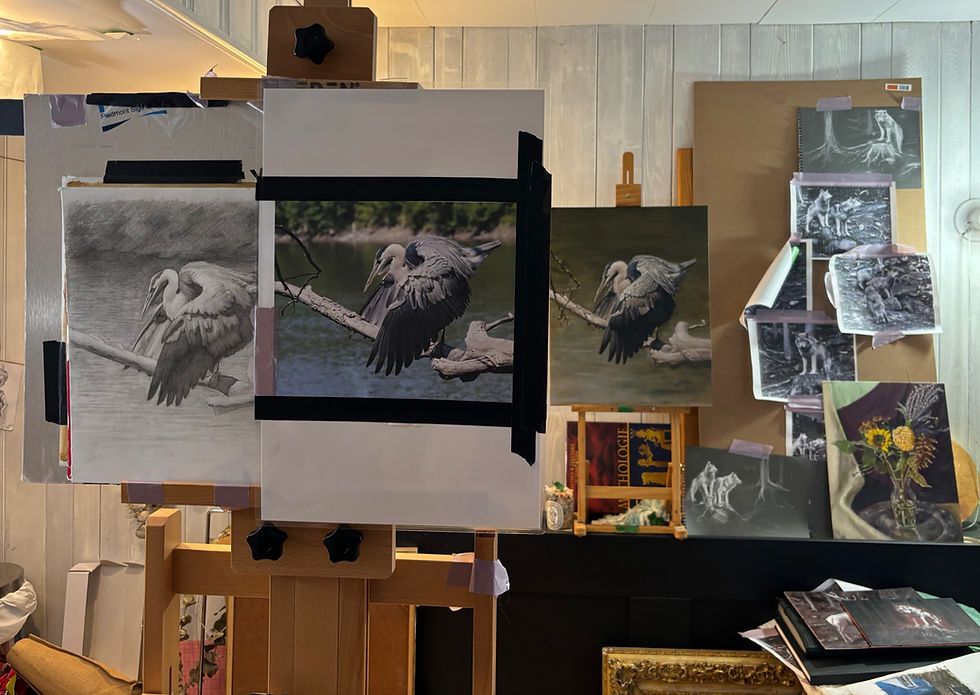
When Technique Stops Being a Wall
I once asked one of my teacher
“When do you stop pushing the technique?”
She replied,
The technique needs to be good enough not to get in the way of your message.
That line still stays with me.
It helped me put technique back in its place — a support, not an armor.
I need to be curious, I need to master enough technique to render my vision.
But, the technique is the apparel, it’s the enveloppe, it is the seduction, it is not the essential, nor the message.
The critic: Careful, it’s not perfect.
The quiet voice: Exactly. That’s how I like it.
Learning to Live with the Blur
Through solitude, nature, and the studio,
I’ve built a space that feels blurry but alive —
safe, anchored.
It’s in that safety that I can allow myself to be vulnerable,
to offer myself the same empathy I give to others,
to approach gently what’s trying to be said.
The critic: What if it’s not enough?
Me: Maybe not.
The quiet voice: But it’s a beginning.
Conclusion — Returning to Myself
The anger that once simmered beneath the surface
led me to look beyond technique.
It brought me back to myself.
It taught me to listen — not to the loudest voice,
but to the one whispering beneath the noise.
To create is to live in this shifting space —
between the critic, the guilt, the doubt, and the quiet voice,
between fear and trust,
between noise and stillness —
where everything meets.
The critic: Will it ever be enough?
The quiet voice: Yes. For now, yes.


Comments