
Curiosity as a Starting Point, Realism as a Path
What I saw, what I believed — and how drawing taught me the difference.
No, it didn’t start at birth — even though I always had colored pencils close by and would take every opportunity to draw.
My journey in art truly began about ten years ago, almost by accident, with a three-hour-a-week class at the Académie des Beaux-Arts de Montréal.It felt light, unpretentious.
But that first drawing marked the beginning of a much deeper path than I could have ever imagined.


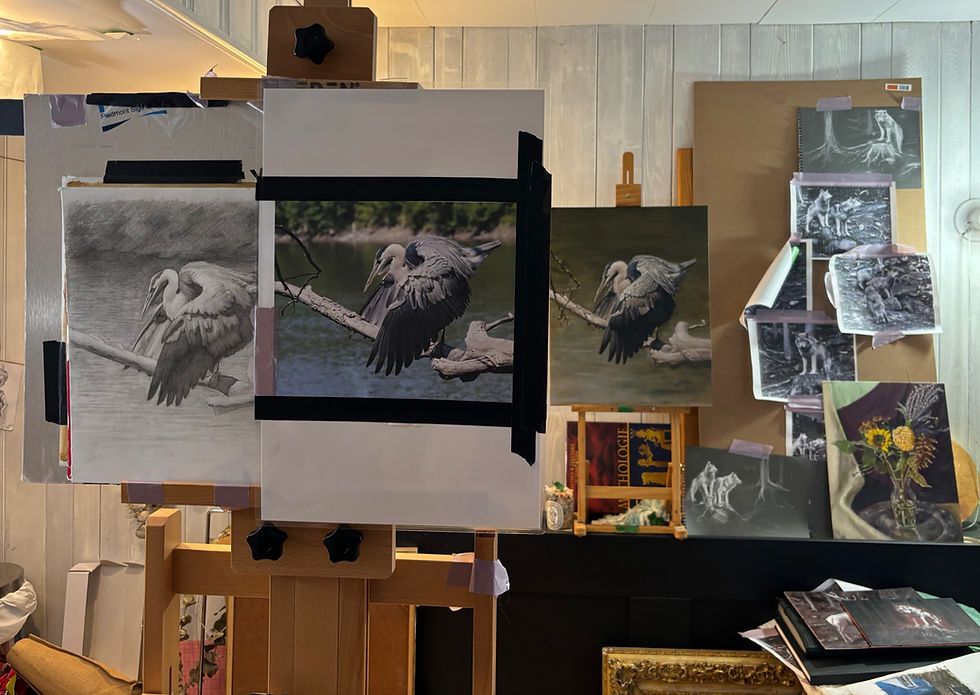
Top left: Still Life oil painting done from direct observation.
First Lines, First Fears
I had chosen a school focused on realistic art per a friend's suggestion.
I wasn’t drawn to abstraction or conceptual work. Realism felt more accessible: more about study, discipline, and a more direct form of communication.
But from the very first class, I froze.
The teacher placed me in front of a decorative squash with odd shapes. She simply said, “Draw that.”
And my mind spiraled: What does she want from me? Am I doing it right? Will I be judged?Suddenly, all my insecurities came rushing in:my need to please, my fear of disappointing, that feeling of being an imposter.
As if I didn’t have the “right eye,” the “right language,” the right to be there.
Learning to See — Truly
What I discovered next left a deep mark: to draw is to learn how to see.
To see without naming or categorizing.
To quiet the mind, and rely only on visual perception — without judgment, without expectation, without rushing to interpret.
It’s harder than it sounds.
From the first lines, the brain tries to take over:This looks like nothing… You don’t have talent… You’ll never get it right…
These thoughts, often unconscious, affect the hand — it tightens.The line stiffens, focus scatters, and we rush to the details.We try to force the likeness.
We forget to see the forest and get lost in the bark.What we observe becomes fragmented, confused.We try too hard, too fast, and lose sight of what’s actually there.
Technique as Mindfulness
Realistic drawing has taught me flexibility — both in the hand and in the mind.
To draw is to make an approximate mark, correct it, try again
.It’s not a straight path even though there are clear steps to follow.
It’s a fluid, organic, sometimes winding exploration.
A dance between perception, intuition and adjustment.
And more than that — it’s an act of mindfulness.When I’m fully present, time slows down. Everything disappears but the object, the project and me.
The thoughts quiet.
But this process can be uncomfortable —not because it’s unpleasant, but because it’s confronting.
It teaches me to stay with discomfort without clinging to it.
What if the Result Isn’t the Point?
Today, I believe the result isn’t the most important part.
It’s what my whole being experiences throughout the process.
Every time I let go of the fear of being judged,
every time I keep going despite doubt,
every time I’m gentle with myself as I erase a line…
…I take one more step toward a freer way of creating.
Conclusion
It was just a class, a gourd, a few pencil lines.But that’s where everything began.And what I learned that day continues to nourish my practice:to see differently, draw differently, and treat myself differently.
Acknowledgments
A heartfelt thanks to the Académie des Beaux-Arts de Montréal, to Romina Sol Catanzaro, and to Audrey Champoux for their essential guidance along this path.


Comments